AVCJ Awards 2020: Fundraising of the Year - Mid Cap: Ascendent Capital Partners
A $500 million investment in Wumart is the exception rather than the rule for Ascendent Capital Partners’ third China fund, but the digital transformation theme is a constant
Within eight months of closing its third China fund on just over $1 billion, Ascendent Capital Partners completed its largest-ever deal, putting $500 million to work with supermarket retailer Wumart. Commitments from Funds II and III totaled $200 million, with LPs contributing a further $300 million in co-investment. With an equity check of that size in the pipeline, why not raise a larger fund?
Liang Meng, founding managing partner of Ascendent, demurs: "The fund size is well-suited to our focus area, which is at the upper end of the mid-cap space. In a volatile market, the mid to upper tier of mid-cap is more attractive. Accordingly, our deal sizes have been at the higher end of our historical range and the downside protection more robust.
"The large-cap space is completely different, with managers writing checks of $500 million. These deals are not large in number. It would be difficult to deploy this amount of capital without going into the growth- and late-stage technology space, where pricing tends to be high."
Among China deals where the equity check was $75 million or above, TMT accounted for 45% of transactions and 53% of capital deployed over the past three years, according to AVCJ Research. This isn't part of Ascendent's strategy, and neither are the sometimes stratospheric, sometimes dispiriting returns that come from backing a start-up at Series C and following it through IPO.
The firm's third fund is two-thirds larger than its second, which closed at $600 million in 2015. The LP base has evolved in terms of geography (it is now 45% North America, 30% Europe, and 25% Asia Pacific) and type (a shift from fund-of-funds to permanent capital providers like pension plans, insurance companies, endowments, and foundations). Meng adds that Ascendent knows a lot more about what investors want from China.
"We are the best fit for LPs seeking sustainable risk-adjusted returns – a commitment that lets them sleep well at night, and will give them above-market returns. If an LP wants exciting concepts and massive outsize returns from China, they can consider higher risk strategies," he says.
Active deployment
With TMT off-limits, Ascendent has still put $730 million, including co-investment, to work over the past 12 months. In addition to Wumart, the firm has backed an education solutions and a consumer services business. A handful of other terms sheets are currently under negotiation.
The approach remains to forge relationships with entrepreneurs and management teams, advise on value-add initiatives, strategic alliances, and acquisitions, and contribute capital when appropriate. "We outperform in volatile environments.," Meng explains. "With things like COVID-19, Sino-US tensions, and regulatory changes create dislocation in the market, companies need advice and ideas, which we are particularly well-placed to provide."
Conditions might be suited to the GP's strategy, but the advice-first approach means that deals can take years to cultivate. Wumart is a case in point. Ascendent has worked with the company on M&A going back at least seven years: the 2013 acquisition of CP Lotus' China business, which was ultimately abandoned; the 2015 purchase of B&Q China, which was completed but the private equity firm passed on the opportunity to invest; and the 2017 acquisition of McDonald's China, where a Wumart-led consortium lost out to another bidder.
In 2014, Ascendent bought a minority stake in a business from a subsidiary of Wumart, Xinhua Department Store. Ningxia Harmony Dairy Development was exited last year when New Hope Dairy bought the company for RMB1.7 billion ($240 million), giving the GP a 2.5x return.
When Carrefour's China hypermarket operation became available, Ascendent advised Wumart to pass on the deal, with Suning ultimately buying the asset. However, the China business of German retailer Metro was different. There were existing B2B and B2C retail channels – and the latter needed a lot of support in going online – while sourcing and quality control systems that came with being part of a multinational were seen as beneficial to Wumart.
Last year, Metro sold the business to Wumart for an enterprise valuation of EUR1.9 billion ($2.1 billion) and took a 20% interest in the combined Wumart-Metro entity. At group level, Wumart has over 1,800 hypermarkets, supermarkets, convenience stores, department stores, and home improvement stores. The Wumart-Metro entity has around 600 outlets and is expected to list in Hong Kong.
Ascendent took a stake in that business at an enterprise valuation of approximately $2.1 billion, having effectively helped finance the Metro acquisition. In addition to agreeing to commit capital from its funds, the GP negotiated an exclusive greenshoe option and marketed the opportunity to its own LP base as well as to the wider investor community. The $300 million co-investment portion was significantly oversubscribed, and numerous participants saw their allocations cut back.
"We have worked with Wumart for many years, and have advised them while closely tracking changes in the retail industry, especially technological disruption in the grocery space," says Meng. "Our fundamental thesis is that traditional retail is here to stay, but it is incredibly important to incorporate online capabilities into traditional retail. A supermarket player must be able to consolidate and take market share."
Addressing disruption
Ascendent expects to see more corporate restructuring and carve-out opportunities as Chinese companies that previously relied on strong macro tailwinds find the new normal more challenging. Across the different deal types, the integration of innovative and traditional business models is a key theme.
Nevertheless, the GP is selective. Top-level buy-in is essential to this kind of transformation. Moreover, there should not only be scope for online expansion, but a robust base underpinned by market entry barriers, favorable geographic locations, or first-mover advantage.
"Then the important question is whether a company has proactive strategies to pursue growth, not just play defense. We seek to pay a reasonable multiple for the defensive piece and at the same time have future aspirations," says Meng.
"When the base case for growth and new ideas come to fruition, we make a great return. Should there be an unexpected downturn, we can always take our money back with a minimum return thanks to robust preparations we make on the defensive aspects of each deal."
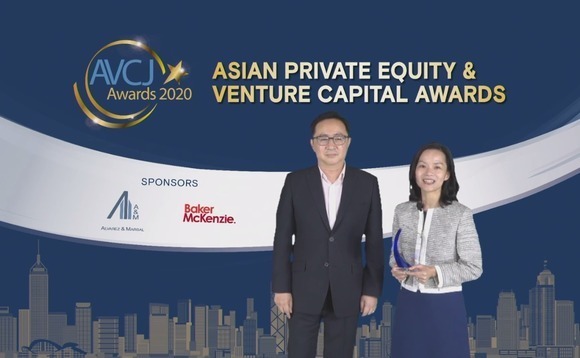
Pictured: Haide Lui of Ascendent Capital Partners receives the Fundraising of the Year - Mid Cap award from AVCJ's Allen Lee
Latest News
Asian GPs slow implementation of ESG policies - survey
Asia-based private equity firms are assigning more dedicated resources to environment, social, and governance (ESG) programmes, but policy changes have slowed in the past 12 months, in part due to concerns raised internally and by LPs, according to a...

Singapore fintech start-up LXA gets $10m seed round
New Enterprise Associates (NEA) has led a USD 10m seed round for Singapore’s LXA, a financial technology start-up launched by a former Asia senior executive at The Blackstone Group.
India's InCred announces $60m round, claims unicorn status
Indian non-bank lender InCred Financial Services said it has received INR 5bn (USD 60m) at a valuation of at least USD 1bn from unnamed investors including “a global private equity fund.”

Insight leads $50m round for Australia's Roller
Insight Partners has led a USD 50m round for Australia’s Roller, a venue management software provider specializing in family fun parks.