

India middle market: Polarization point
Increased deal flow towards the top end of India’s private equity market is stretching the capacity of mid-tier local managers. What are the implications for co-investment and fund size?
By most metrics, EuroKids International represents the successful execution of a scale opportunity. Gaja Capital led a INR2.2 billion (then $40 million) buyout of the Indian education business in 2013 and launched an array of initiatives aimed at realizing more value from existing operations and focusing on higher-margin products. Cash from these improvements was channeled into add-on acquisitions.
When Gaja exited to KKR in September – generating a 5x gross multiple in rupee terms – EuroKids was serving 120,000 students across 1,115 pre-schools and 35 K-12 facilities. Revenue and EBITDA were INR4 billion ($56 million) and INR1 billion, respectively, representing a fourfold and a tenfold increase during the holding period.
EuroKids is a strong endorsement of India's nascent buyout market and the value creation capabilities of smaller managers. It also highlights the chasm that exists in the GP community. This was a large transaction for Gaja, with co-investors contributing about one-third of the equity. For KKR, on the other hand, it was a small deal – one of those rare occasions when the firm dips below its preferred check size range of $200-500 million.
These size dynamics characterize a market that is arguably more stretched than any in Asia. India is still recalibrating after a period of consolidation that left only about 20 active country managers in the lower middle segment, with funds of less than $500 million. Meanwhile, the global and pan-regional players are seeking bumper deals for their ever-larger pools of capital. Between these two camps are half a dozen upper mid-market GPs confronted by a much wider addressable universe.
Atul Kapur, co-founder and CIO of Everstone Group, captured the sense of flux at the AVCJ Forum when discussing the frustrations of exiting assets to other financial sponsors. Everstone – one of the upper-middle market six alongside ChrysCapital Partners, Kedaara Capital, Multiples Alternative Asset Management, Tata Opportunities Fund and True North – wants to sell to global and pan-regional firms but their minimum check sizes are often out of reach, even after a concerted expansion effort.
"No one wants to write a check of less than $200-300 million and that is becoming a deciding factor as to what the input is if you want to make 2.5-3x your capital," Kapur says. "There is a yawning gap between the mid-market – funds of $700 million to $1 billion – because the next leg up is $6-12 billion. In the US and Europe, there is enough depth in each tier as assets progress upwards. But in Asia there's a gap and it's forcing mid-market funds to increase in size and buy bigger businesses."
Going large
Exit angst is not the only force driving upper middle-market managers up the value chain: they are seeing more opportunities to put capital to work in larger deals, with control transactions growing in volume rapidly from a low base.
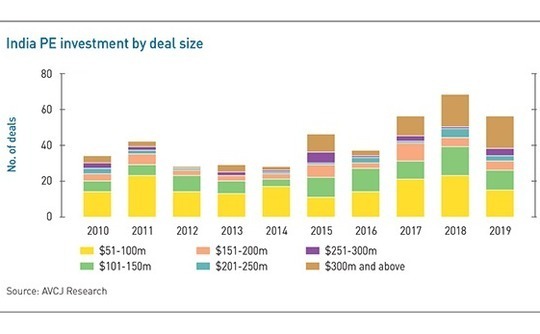
There were about 40 private equity deals in excess of $50 million in India in 2011, of which half were sub-$100 million, according to AVCJ Research. This remained comfortably the most active segment for the next three years, with roughly three-quarters of all transactions failing to cross the $150 million threshold. The landscape shifted in 2015 as the number of $50 million-plus deals reached a new high and investments of $151 million and above were in the majority for the first time.
Since 2015, average annual transaction volume in the $151 million to $300 million space stands at nearly 12, up from seven for the five years before that. Moreover, over the two periods, the average number of deals in excess of $300 million has risen from three to 12. There were 18 in 2018 and there have already been 18 so far this year. The 2019 contingent features a handful of infrastructure and late-stage technology deals, but traditional private equity is well represented.
"India is going through an unprecedented debt crisis and this has led to select corporates selling assets in order to fund their core business," says Rupen Jhaveri, a managing director with KKR. "This doesn't mean we are buying distressed assets, but we are able to select the good businesses and invest in their growth, while at the same time providing the sellers with much-needed liquidity. This has become one of our most active channels for sourcing new opportunities in the current environment."
The equity check size for the firm's last four India deals ranges from $150 million to $500 million. EuroKids likely sits at one end of this spectrum, while the other is occupied by Ramky Enviro Engineers, an environmental services company in which KKR acquired a 60% stake for $530 million last year. The latter was a corporate carve-out. Jhaveri notes that there is no desire to constrain the team with absolute minimums and maximums in terms of deal size, but the firm is unlikely to go below $200 million unless it's for control of a high-quality asset.
It is difficult to divide the market into distinct segments based on deal size due to variations in appetite and strategy. Just as some global buyout players are more willing to flex downwards more than others, among the upper middle-market managers, True North is wedded to buyouts, ChrysCapital still for the most part takes minority positions, and Kedaara is somewhere in between. But every mid-size GP senses an opportunity as the likes of KKR target larger investments.
"When the larger buyout funds started in India, they were doing $50-75 million deals. They were learning about the market and bigger investments weren't available anyway," says Udai Dhawan, head of India PE at Affirma Capital, formerly known as Standard Chartered Private Equity. "In the last five years they have moved up and this has left a space for us."
LP accomplices
While Affirma remains in the $50-75 million space, emphasizing its global network as a differentiating factor, other GPs are pushing upwards. True North, which raised $600 million for its last fund, has an average check size in the $75-100 million range, but it has committed up to $300 million and has looked at situations that require $500 million in equity. LPs come in as co-investors when the fund reaches its limit.
ChrysCapital has a sweet spot of $75-90 million, but it can deploy as little as $30 million and as much as $150 million from its fund – the eighth iteration closed earlier this year on $867 million – with co-investors putting equity checks of $300 million in range.
Up until last year, the firm had barely tapped LPs to participate in deals. Then it swooped in and took a minority stake in Mankind Pharma from under the noses of two global GPs. Four LP co-investors came into the $325 million deal.
"As we looked through the data, we saw that you can make money whether it's minority or control, primary or secondary, public or private, large or small. The only underlying theme is that you should be investing in better run sectors: healthcare, financial services, consumer, IT services," says Gaurav Ahuja, a managing director at ChrysCapital. "Why give up on large deals if you know these sectors well? If we have operating experience in a sector, we shouldn't let the deal size constrain us."
This flexibility on deal size doesn't sit well with everyone. Affirma's Dhawan cautions that it can lead to a loss of focus as investment professionals struggle to understand what should be prioritized. At the same time, a GP's value proposition might be diluted when applied to larger companies that already have professional management teams, adequate internal systems and processes, and clear product development strategies.
"When we focus on the mid-cap space, we are working with family-run companies and helping them institutionalize. That is what we have a recipe book for, a toolkit for, a whole transformation process for," he says. "If you are doing larger deals, you need a different skillset, your influence on the company is going to be different if it's a minority situation, and your access to diligence will be different."
In addition, with co-investment, there are no guarantees. According to Srikrishna Dwaram, a partner with True North, the firm delivered about $400 million in co-investment on top of the $700 million deployed from its fifth fund. However, True North's latest vehicle is about 50% deployed and co-investment stands at zero because certain deals haven't gone through. Equally, co-investment capacity might be lower than expected because LPs don't respond to opportunities fast enough.
Size matters
What remains to be seen is how this dabbling in larger deals and co-investment is impacted by increasing fund sizes. ChrysCapital raised $1.25 billion for its fifth vehicle in 2007 but then cut it back to $960 million because there weren't enough big-ticket opportunities. Similarly, True North abandoned the $1.1 billion hard cap set on launching its sixth fund in late 2017.
ChrysCapital, which aims to deploy $200-250 million per year, excluding co-investment, might justify surpassing $1 billion in the next vintage purely based on an anticipated increase in check size driven by economic growth. Opinion is divided as to whether this is advisable.
"The experience with larger funds has been disappointing in the past because the scale of those funds has not been in sync with the underlying deal flow," says Praneet Garg, a managing director with Asia Alternatives. "Now, I think middle market players are a lot more thoughtful and cognizant of building their teams and operating capabilities and delivering cash on cash returns. If they continue to perform there is no reason why they can't raise larger pools of capital."
Getting there requires a conviction that the historic trend of deal flow thinning out in the upper echelons can be confounded. This is not shared by all GPs: "How many managers can consistently deploy $200-250 million a year? Not many," says one local investor. One area of potential middle ground is a sidecar vehicle, already employed by the likes of Multiples and True North, that allows the firm to scale up as and when required.
Indeed, Haresh Vazirani, an investment director at Aberdeen Standard Investments, contends that only or two groups will make it past $1 billion. "Most of these funds have large cornerstone investors who come because they get decent co-investment rights. If the fund exceeds $1 billion and co-investment goes down significantly that might change the LP's appetite. It's hard from that position for someone to say they want to go up in size and offer more co-investment," he observes.
Where there is general agreement is that India is unlikely to follow the developed market pattern of growth in deal and fund sizes across the spectrum. In the near term, at least, smaller managers are not going to fill the space vacated by upper middle-market players looking to write bigger checks. The LP perspective is that track records are thin, teams are small, and it will be difficult to attract and retain talent given larger groups are hiring. For their part, these GPs ask why they would leave a segment that remains underpenetrated and lightly contested.
A potentially beneficial side effect of this polarization is that it facilitates private equity-to-private equity deals – especially if upper middle-market managers can use co-investment to nurture companies that appear on the pan-regional firms' radar. Secondary exits have yet to take off in India; since 2015, the annual average deal volume is about 20, a modest increase on the previous five years. But India's total is more than twice that of China, despite its overall exit volume being lower.
"The India market is going to be faster in its evolution of secondary sales than the other emerging markets, including China. This is partly due to the consolidation of capital in different pockets – the smaller end of the middle market, the middle market, and the large-cap space," says Garg of Asia Alternatives. "Passing the parcel becomes easier if there is a clear concentration of capital in these sub-segments."
More on South Asia



Latest News

Asian GPs slow implementation of ESG policies - survey
Asia-based private equity firms are assigning more dedicated resources to environment, social, and governance (ESG) programmes, but policy changes have slowed in the past 12 months, in part due to concerns raised internally and by LPs, according to a...

Singapore fintech start-up LXA gets $10m seed round
New Enterprise Associates (NEA) has led a USD 10m seed round for Singapore’s LXA, a financial technology start-up launched by a former Asia senior executive at The Blackstone Group.

India's InCred announces $60m round, claims unicorn status
Indian non-bank lender InCred Financial Services said it has received INR 5bn (USD 60m) at a valuation of at least USD 1bn from unnamed investors including “a global private equity fund.”

Insight leads $50m round for Australia's Roller
Insight Partners has led a USD 50m round for Australia’s Roller, a venue management software provider specializing in family fun parks.