

AVCJ Awards 2018: Fundraising of the Year - Large Cap: Affinity Equity Partners
Communication and discipline helped Affinity Equity Partners complete a first and final close of $6 billion on its latest pan-Asian fund within four months
Support from existing investors and sticking to a clear timeline are the key contributing factors to a speedy fundraise. Affinity Equity Partners achieved just that at the end of 2017, reaching a first and final close of $6 billion on its fifth pan-Asian fund. The firm took just four months to complete what was at the time the largest single close ever seen in the region. The re-up rate was 95%.
"We are in a good position as we have the support of our existing investors, so the fundraise is less about finding new capital. But having a timeline that we communicated to LPs up front and then sticking to it from an execution perspective was important," says Queenie Ho, a partner at Affinity. "We were clear about when we would issue the PPM [private placement memorandum], when we would send out the LPA [limited partnership agreement], and when we would need comments back. When we came to market, we had already told LPs we wanted to close by year-end."
The process was largely the same as for Fund IV, which closed at $3.8 billion in early 2014. Affinity organized two separate structured due diligence sessions in Hong Kong that were attended by nearly 50 investors from different parts of the world. The private equity firm's country teams and portfolio company CEOs took part in more than 300 meetings over four days.
In addition, it responded to over 140 investor due diligence questionnaires and follow-up inquiries. The draft LPA was issued in October 2017 and negotiations were completed in within two months.
A rising tide
Affinity is said to have generated a 3x gross multiple and a 29% IRR on its exited investments to date. As of June 2018, the multiple and IRR on Fund III were 1.93x and 16.6%, respectively. Fund IV was tracking even better, given its relative youth, with a multiple of 1.69x and a 31.2% IRR. At the same time, the fundraise coincided with a buoyant period of private equity generally. Several pan-Asian GPs have been notable beneficiaries, increasing their fund sizes on the previous vintage and closing in short order.
"When we were in the market in 2017, for many institutional investors, private equity was the top-performing asset class and they were increasing allocations. And there are still many LPs who are underweight on Asia based on the region's share of global GDP," says Ho. "Compared to our last fundraise, we found there was stronger appetite for pan-Asian managers than country-focused GPs. And then there are new investors and pools of capital that are starting to deploy."
The LP breakdown by geography (39% North America, 26% Asia Pacific, 20% Europe, and 15% Middle East) and by investor type (49% pension funds, 25% sovereign wealth, 15% financial services, 6% fund-of-funds, and 5% endowments, foundations and family offices) is much like the previous fund. But the 5% that weren't re-ups include some names that are new to the asset class.
"For investors who are new to Asia PE, there may be a lot of education about the general landscape. They might do it on their own or engage an advisor to profile the market and the key players. When you run into that, if you are only in the market for four months, you need to form a view whether it's a critical LP and how much time and effort you have to get them up to speed," Ho explains. "For some, it would be nearly impossible to get from landscape to commitment in four months."
Meanwhile, other newcomers to Affinity are not newcomers to Asia private equity. Ho notes that investors with mature programs may not seek new GP relationships unless they are thinking about replacing an existing manager. This is beginning to happen in Asia as LPs have gone through a few fund cycles with private equity firms and have enough information to decide which ones they want to keep.
Size matters
Affinity set out with a target of $5 billion but ended up with a fund that is 58% larger than its predecessor. Most private equity firms in this situation experience some pushback from LPs and the tension is usually tied to co-investment. Half of Affinity's LPs now have active co-investment programs, compared to a handful two or three funds ago. The larger the fund, the less co-investment capacity, assuming the opportunity set is unchanged.
As a result, LPs scrutinize a manager's historical and future pipeline on a bottom-up basis, seeking to establish whether the proposed increase in fund size is justified. There are more questions about deal types, target industries, and key themes – anything that could contribute to higher investment volume or value.
Another issue that comes up in discussions about fund size is competition. Is there a mismatch between the investment opportunities available in Asia's large-cap space and the amount of capital chasing them? Affinity claims that 80% of its transactions to date have been proprietary, but Ho agrees that the level of competition is intensifying. The firm's response is to continue to upgrade the skills and resources it has at its disposal, especially in terms of people.
"It's not just the team but the broader network of external advisors who work with us exclusively or non-exclusively," she says. "We don't have an operating team per se, but we do rely a lot on our network of executives and industry veterans, many of whom have been CEOs or board members for our portfolio companies. One executive in Korea has been CEO of two different portfolio companies and acted as board member for a third. After owning 15-16 companies in Korea, many executives have worked with us across multiple companies in different capacities."
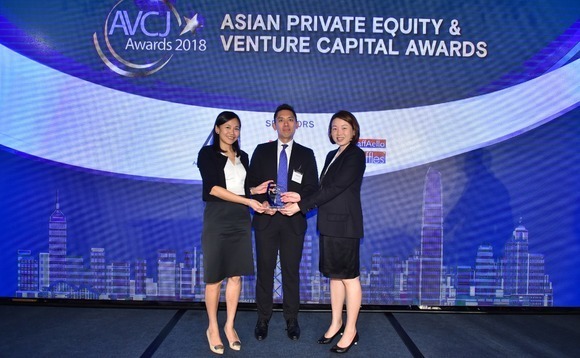
Pictured: Queenie Ho (left) and Tracy Ang (right) of Affinity Equity Partners with Kelvin Poa of Baker McKenzie
More on Fundraising




Latest News

Asian GPs slow implementation of ESG policies - survey
Asia-based private equity firms are assigning more dedicated resources to environment, social, and governance (ESG) programmes, but policy changes have slowed in the past 12 months, in part due to concerns raised internally and by LPs, according to a...

Singapore fintech start-up LXA gets $10m seed round
New Enterprise Associates (NEA) has led a USD 10m seed round for Singapore’s LXA, a financial technology start-up launched by a former Asia senior executive at The Blackstone Group.

India's InCred announces $60m round, claims unicorn status
Indian non-bank lender InCred Financial Services said it has received INR 5bn (USD 60m) at a valuation of at least USD 1bn from unnamed investors including “a global private equity fund.”

Insight leads $50m round for Australia's Roller
Insight Partners has led a USD 50m round for Australia’s Roller, a venue management software provider specializing in family fun parks.